
A Study on Ketu: Our Reserves
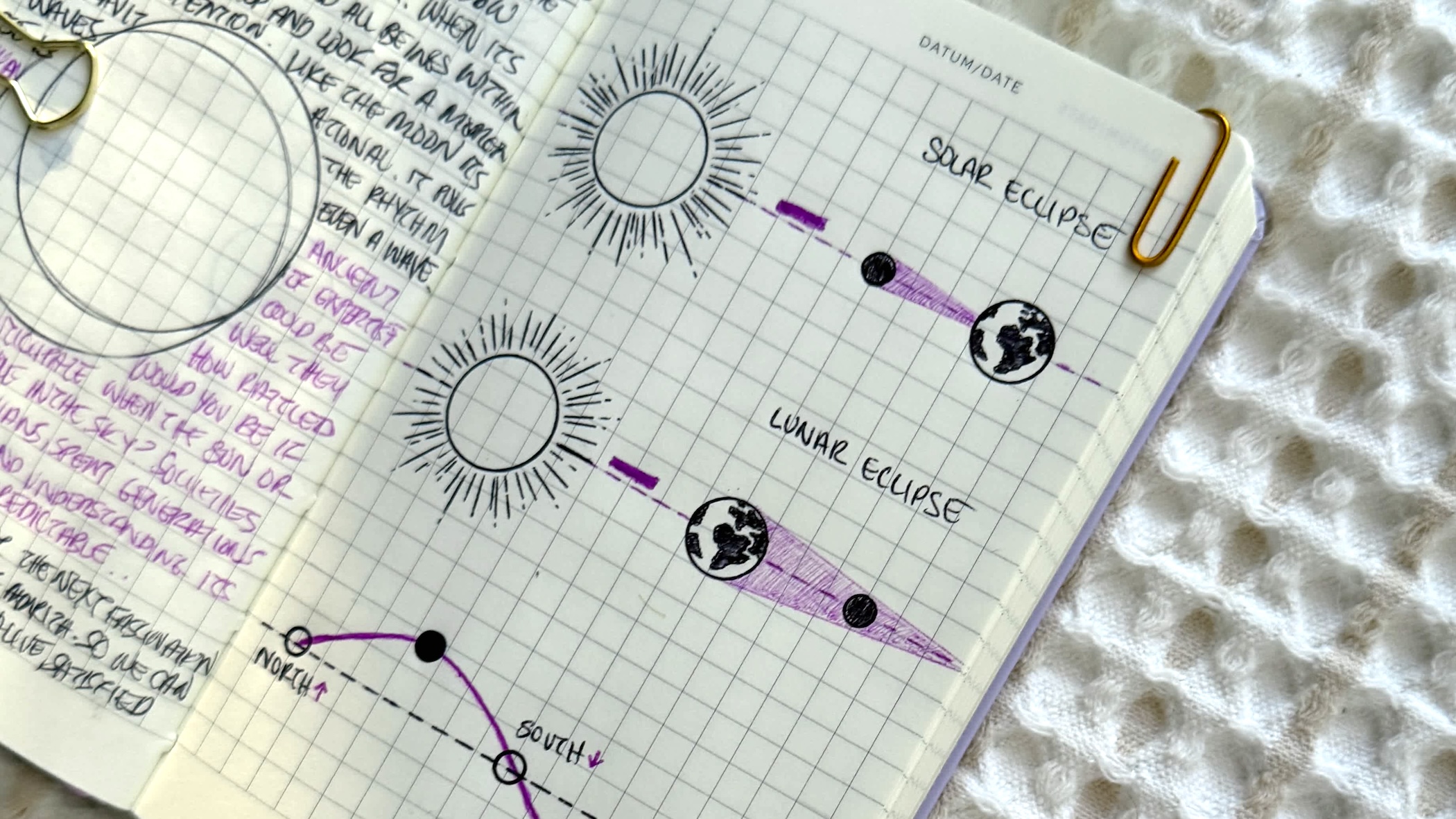
Let’s think about what the Nodes do. They eclipse the Sun and the Moon, meaning: the Sun or Moon align with Earth and become obscured by a shadow. The closer the alignment, the more the shadow covers and the more fanfare surrounds it. During a total eclipse darkness falls and all beings within this shadow are forced to stop and look – even for a moment.
One could say an ancient society's level of expertise and intelligence could be measured by how well they could time eclipses. How rattled and bewildered would you be, if you could accurately anticipate when the Sun or Moon becomes a black hole in the sky? Ancient societies, like the Maya and Babylonians, spent generations collecting data on this phenomenon and understanding its pattern until it became... predictable.
Is it always safe to say, the more predictable the event, the less mysterious it is? Furthermore, the more predictable the event, the more we take it for granted?
Many echo that the South Node (Ketu) is a difficult and nebulous point in the chart – a point that's hard to grasp and corresponds with disillusionment. The common semantics describe it as a point of “drain”. It represents the side of ourselves we "ought to move away from" and let go while the North Node (Rahu) represents our new purpose and what we're here to pursue.
William Lilly is the voice traditional astrologers might reference a lot: in Christian Astrology (1647) he treats the North Node (Rahu) as beneficial and the South Node (Ketu) as destructive. This has been inherited from medieval astrologers like Bonatti. Then came 20th-century astrologers such as Dane Rudhyar (1930s), and later the evolutionary astrology crowd (deserving of a major side eye), who introduced and popularized the past-life (Ketu) and purpose (Rahu) interpretation of the nodes.
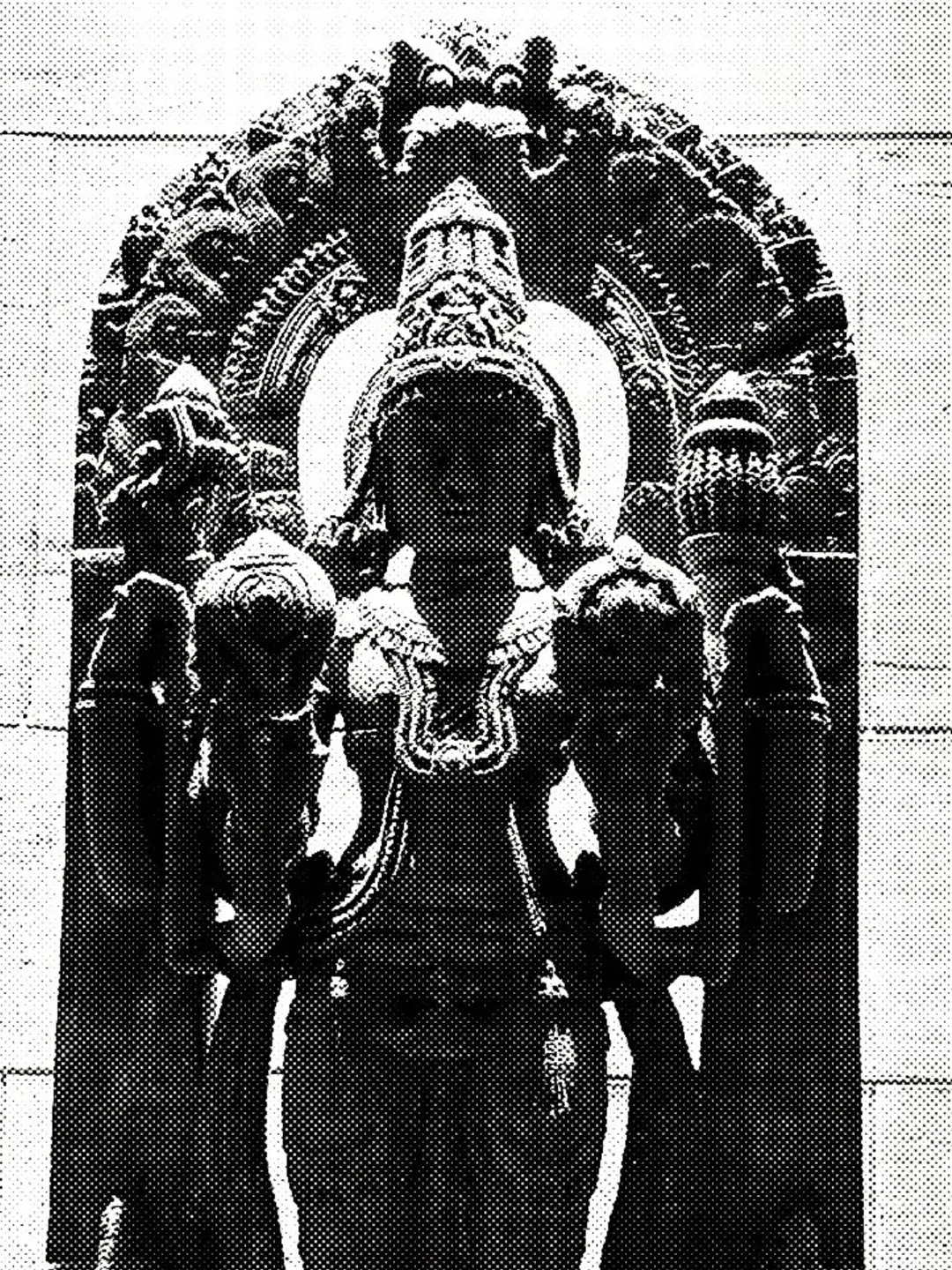
Vishnu, preserver of cosmic order. A pivotal figure in the story of the nodes. Keep reading... More on this later.
In classical Vedic astrology (as R. Santhanam’s notes to the Brihat Parashara Hora Shastra put it), Ketu has no fixed role on its own in the chart. It depends on its relationship to the chart and other house rulers; if Ketu is connected to a malefic it’s challenging, if connected to “good lords” it gives “favourable” effects.
(But let's be honest, when analyzing the chart holistically – as any skilled astrologer would – this can be roughly said for any placement.)
Classical Jyotish reads the whole chart as the result of past-life deeds and ties Ketu to the 12th house and liberation. Modern Jyotish interpretation delineates Ketu as a storage of our “past-life” skills... that we ought to outgrow...
In most cases, the nuance that I challenge the most are interpretations made based on value judgment – this idea that we "ought to" or that we "must" move away from, or out grow, whatever our Ketu placement represents.
I'm careful not to make blanket statements about what one "must do" over the totality of their life, because astrology has taught me to embrace the cyclical nature of our journeys. Sometimes that means learning lessons, revisiting lessons, forgetting and remembering.
I lean toward the modern view that Ketu is a storage of our known skills or what we already have – to the extent we may even take it for granted, because it could always be there (cue Janet Jackson - Got ’Til It’s Gone).
Pattern tells me it points to the people, things, or places that we can lean back on, regardless of the moral implications or if we "like" it or not. It describes places or a resource you can use up – when you're forced to, when you need to, or even when you want to. In that light I see the semantic connection with "drain" and dissolution. Perhaps the obscurity is more rooted in a familiarity kind of way (Moon), and less a distortion kind of way (Neptune).
But, indeed, there are times when it's our saving grace. Albeit, you need a bit of stoicism to believe it, but at least it was there to pad the fall. And of course, depending on the configuration of your Ketu, not all paddings are made the same. That's the work I choose to take on when helping someone understand their Ketu - what is it made of? What kind of padding is available to you, should the time come and circumstances position you to have to fall back on it.
The Nodes In Practice
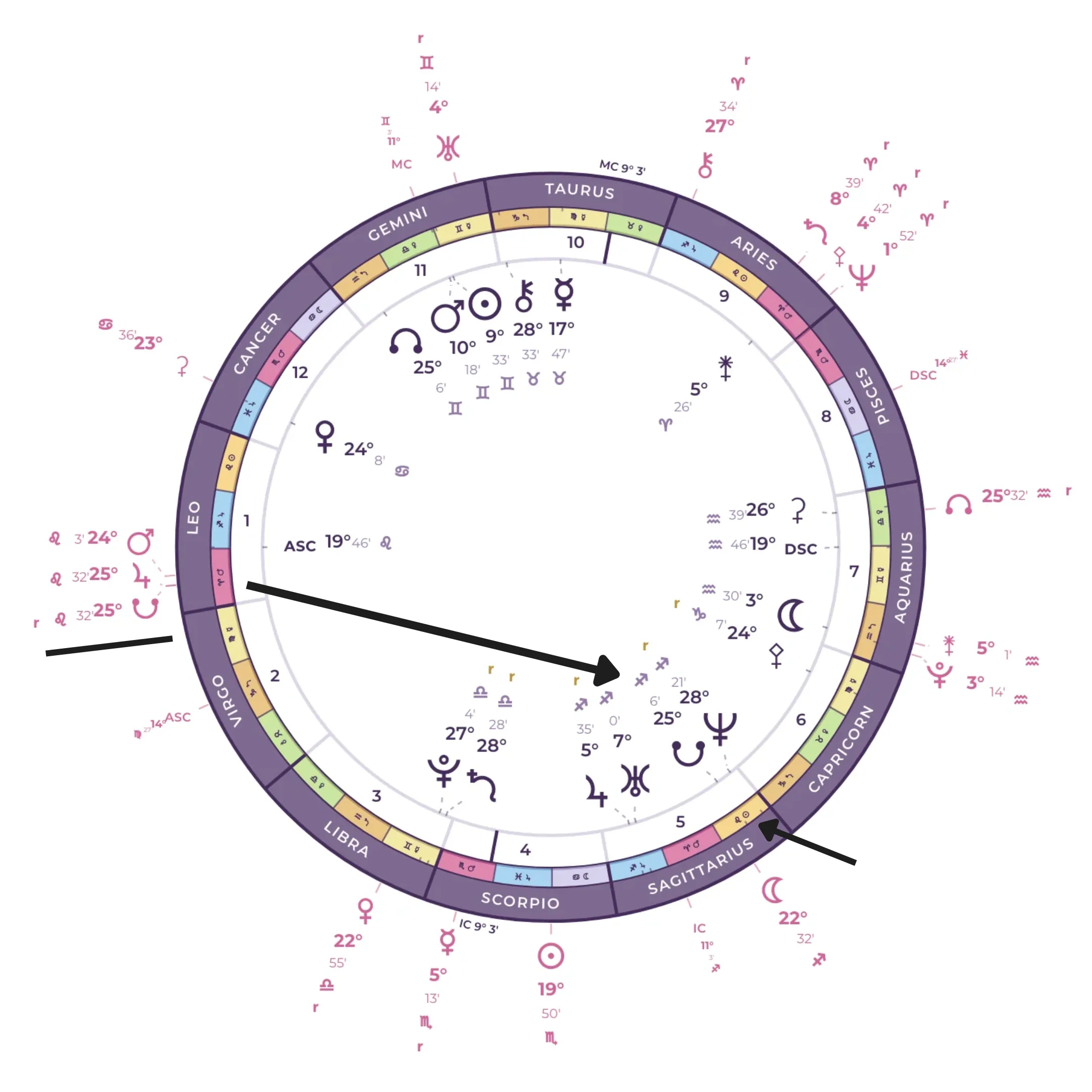
Recently, I worked with a Leo Rising and Gemini Sun in the midst of navigating a very necessary vehicle purchase amid a financially difficult time. (Thank you for your permission to share!) Look at the transiting Jupiter/Ketu conjunction trining their natal Ketu at 25º just short of 26 minutes of arc.
I've found Jupiter to correspond with larger vehicles intended for long distance travel, while Mercury points to smaller modes of transportation. In other words, while Mercury can signify cars, I've seen Jupiter correspond with it a lot.
Now let's remember, a trine doesn't always mean a pleasant or "softened" experience – it only means the exchange between the two placements are "easier" to communicate, blend, exchange etc. What was meant to be a fairly straightforward purchase became a challenge, with a lot of runaround, and a series of unforeseen expenses.
Jupiter is the traditional ruler of Pisces and ruler of the natives 5th and 8th house. Transiting Jupiter's trine to natal Ketu tells us of the multiplying (Jupiter) debts (8th ruler) and unforeseen expenses (Pisces) required to get the vehicle. In order to meet those expenses, this included having to sell a very precious and valuable investment – a meaningful portion of their gold jewelry collection. Ouch.
Natal Ketu in Sagittarius sits in the 5th house, in the third decan, which by triplicity is ruled by the Sun. The Sun and Leo correspond with gold and jewelry – and in the 5th house no less, signifies personal investments and the things that give us great pleasure and joy.
| Ketu in Sagittarius | 5th House | Leo Decan | Jupiter |
|---|---|---|---|
| Natal Ketu in the 5th describes the personal investment involved | |||
| Natal Ketu in Sagittarius, Leo/Sun decan, points to the nature of the investment | |||
| Transiting Jupiter/Ketu not only describes the overall event of seeking out mobility and transportation, but also echoes the specific activity of "letting go" of an investment for the sake of mobility | |||
Jewelry collecting for this client isn't a vain hobby. They have pieces that were inherited, and new ones added to the collection are intended for heirloom purposes. You're going to tell me, that I should tell them that they "should outgrow" this? To tell them that this very near, dear, and valid tradition is somehow spiritually holding them back?? This doesn't seem realistic or even spiritually honest to suggest.
Editing spiritual flourish, the chart tells me this was the storehouse that they could fall back on when it was time to do something out of great necessity. What they've accumulated, described by Ketu, would allow them to move forward – and yes, it was extremely difficult to accept. Maybe one could spin this as yet another chapter of "spiraling" into materialism and swapping out attachments, but getting this vehicle solved very real problems that involved children and work – among other critical reasons.

This is why I save the value judgment. I see a more constructive path supporting clients when describing Ketu as a reserve, minus all the should-be-isms.
There are times when it hurts deeply to have to give up what we've collected and embedded in our lives over the years.
Perhaps it's just as devastating as losing several generations of collected data that help a society know when the next eclipse is coming.
Perhaps, it's a welcome back to square one.
Diving Deeper
To say that the Nodes represent our calling and purpose is not specific enough for me. I think the entire chart represents our purpose and tells us where we're heading in life, not just the North Node alone. Sorry, evolutionary astrology.
There's another specific nuance to Ketu-Rahu that I started to notice after working closely with clients and providing 30-day schedules. These schedules involve a planet tracking technique that calculates planetary timing windows, where 2 - 4 days accurately describe activities and events. This progression technique is the spine of the personalized calendars I provide in my readings (it's not monthly profection, firdaria, dashas, or zodiacal releasing if you're wondering).
Let me explain: There are distinct days in our week where a clear activity has happened. You had a hair appointment, then maybe the next day, you deep cleaned your cupboards, a day after that, you head to the flea market and a nice vendor adds an extra item in your purchase. Timing would have it, when your planetary windows are calculated, that timeline corresponds with a Virgo Venus motion.
You guessed it, these 30-day schedules also include a timing window for nodal events. This is how my clients and I understand what planets mean more precisely on a personal level. It's also an excellent way to refine general interpretations and keywords. In the exclusive portion of this article, I share some examples and discuss another signification I've seen emerge for Ketu-Rahu.
A Study On Ketu: What We See Through
Further reading and acknowledgements
William Lilly, Christian Astrology (1647)
Guido Bonatti, Book of Astronomy, trans. Benjamin Dykes
Brihat Parashara Hora Shastra, trans. R. Santhanam
The Astrology Podcast, ep. 290, "The Early History and Meanings of the Nodes"
Bhagavata Purana, Book 8
A special thank you to the clients who generously shared their charts and stories for this article. You know who you are.